Is this my interface or yours?

Why do products sometimes label things as my stuff, and sometimes label things as your stuff?
Interesting post by John Saito on the use of different points of view in user interfaces.
via medium.comWhy do products sometimes label things as my stuff, and sometimes label things as your stuff?
Interesting post by John Saito on the use of different points of view in user interfaces.
via medium.com
Without beautiful, precise pictures of the product we wish to create, how do we gain resources to actually make them a reality? This new approach would turn the process on its head: it makes building and designing something one and the same. Rather than creating and presenting a design prototype, only to dismantle it in order to build and present a functional prototype (often at a lower quality), the functional prototype itself becomes the presented artefact, greatly reducing the cost of making it a stable, complete product.
The burden and responsibility of precise, perfect design should be shared between designers and engineers. The fact that this is true for every other related industry—architecture, industrial design, printed matter—and not for digital product design is indicative of nothing but the immaturity of our tools, processes, and philosophy.
Daniel Eden on the current state of design tools and workflows, short and on point.
I have always believed we need to stop treating design and development as two distinct disciplines and start following a more cohesive and authentic approach.
via daneden.me
Nice video from Vox and 99% Invisible’s Roman Mars about biomimicry.
It reminds me of Bruno Munari’s analytical study of plants and fruits in his must read Design as Art, in which he meticulously describes and praises the essential features of natural objects as a source of inspiration:
This object [an orange, an almost perfect object where shape, function and use display total consistency] is made up of a series of modular containers shaped very much like the segments of an orange arranged in a circle around the vertical axis. Each container or section has its straight side flush with the axis and its curved side turned outwards. In this way the sum of their curved sides forms a globe, a rough sphere.via youtube.com
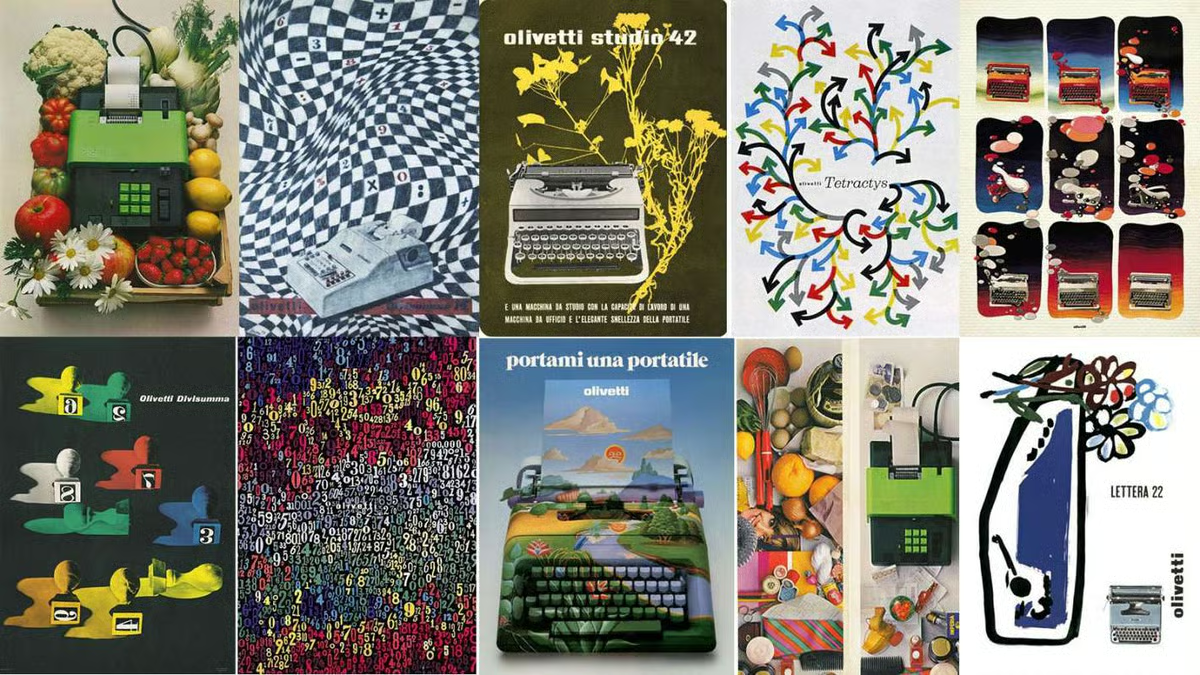
A politician, as well as a chemical engineer and entrepreneur, Olivetti had a philosophical view of entrepreneurship, one that put people and communities at the center of a business. He was a firm believer in the competitive advantage of treating workers fairly and investing in their wellbeing. Andrea Granelli, president of Associazione Archivio Storico Olivetti (Olivetti’s historic archive association), told Quartz “the profits from sales were invested in innovation, expansion, higher salaries, social services.”
Looking back at the rise and fall of Adriano Olivetti’s vision for sustainable and socially responsible entrepreneurship is both depressing and extremely inspiring at the same time. So many lessons to learn from that experience.
via qz.com